
Many organizations believe they have 24x7 security monitoring because alerts are generated around the clock. Logs are being collected. A provider may be watching a queue. An internal team may receive after-hours notifications.
But 24x7 monitoring is not always the same as 24x7 SOC coverage.
The distinction matters because security operations are not defined by whether a tool can produce an alert at 2:00 a.m. They are defined by what happens after that alert appears. Who reviews it? What context do they have? Can they connect the signal to related activity across the environment? Do they know when to escalate? Is someone accountable for driving the next step? Is remediation tracked through closure?
That is the gap between detection and response. Detection tells you something may be wrong. Response determines whether the organization can act on it in time.
For IT and security leaders, the better question is not, “Do we have 24x7 monitoring?” It is, “Can a security event move from signal to decision to action at any hour?”
Monitoring Is Only the Starting Point
This matters because security events do not wait for business hours. The FBI reported ransomware attacks impacted 870 critical infrastructure organizations, making after-hours coverage an operational workflow challenge rather than simply a notification challenge.
Around-the-clock visibility is important, but visibility alone does not reduce risk. The real value of a SOC comes from the operational process behind the monitoring: analyst review, threat validation, severity assessment, escalation paths, and response coordination.
In other words, 24x7 monitoring answers the question, “Are alerts being collected?” A well-structured SOC model answers the more important question: “Is the organization prepared to act when those alerts matter?”
The challenge is not whether alerts exist. It is whether the organization can consistently investigate, escalate, and act on them at any hour.
That happens often in growing organizations. The internal team may already be stretched across identity, endpoint, network, cloud, email, applications, infrastructure, user support, and compliance. They may have capable tools in place, but limited capacity to interpret and act on alerts around the clock. For lean internal teams, the issue is not effort. It is capacity. ISC2’s 2025 Cybersecurity Workforce Study points to ongoing skills and staffing shortages, budget pressure, and the need for specialized capabilities as factors that affect security resilience. That is why many organizations need to evaluate whether their current model can sustain 24x7 review, escalation, and response without relying on informal heroics. Real SOC coverage reduces uncertainty in after-hours response by establishing clear workflows, escalation paths, and ownership.
According to ISACA, more than half (55%) of cybersecurity teams are understaffed as organizations work to manage growing threat complexity and operational demands with limited resources and increasing workload pressure. TechRadar reported that 76% of cybersecurity professionals experienced fatigue or burnout in 2025, while ISC2, the world’s leading member association for cybersecurity professionals, found that 47% feel overwhelmed by their workload, highlighting the growing strain many teams face as responsibilities continue to expand across leaner IT and security organizations.
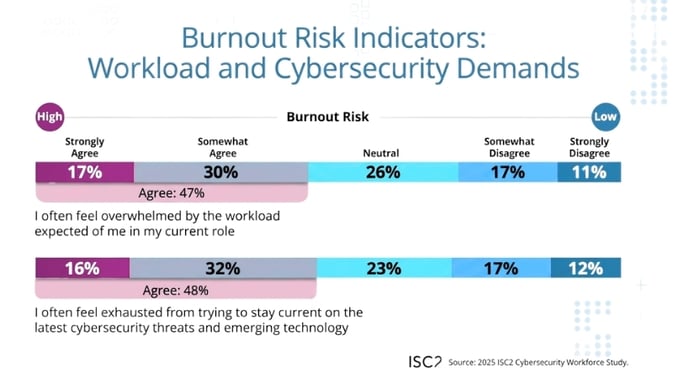
At the same time, ongoing workforce reductions and operational restructuring across the technology sector are placing additional pressure on stretched cybersecurity teams. 72% of respondents agreed that reducing cybersecurity personnel significantly increases the risk of a breach, increasing the need for dependable SOC coverage and operational resilience.
By serving as a trusted extension of the team, VectorUSA helps reduce the operational strain on internal teams by providing consistent coverage and enabling internal teams to stay focused on high-value strategic initiatives.
Real Coverage Is an Operational Workflow
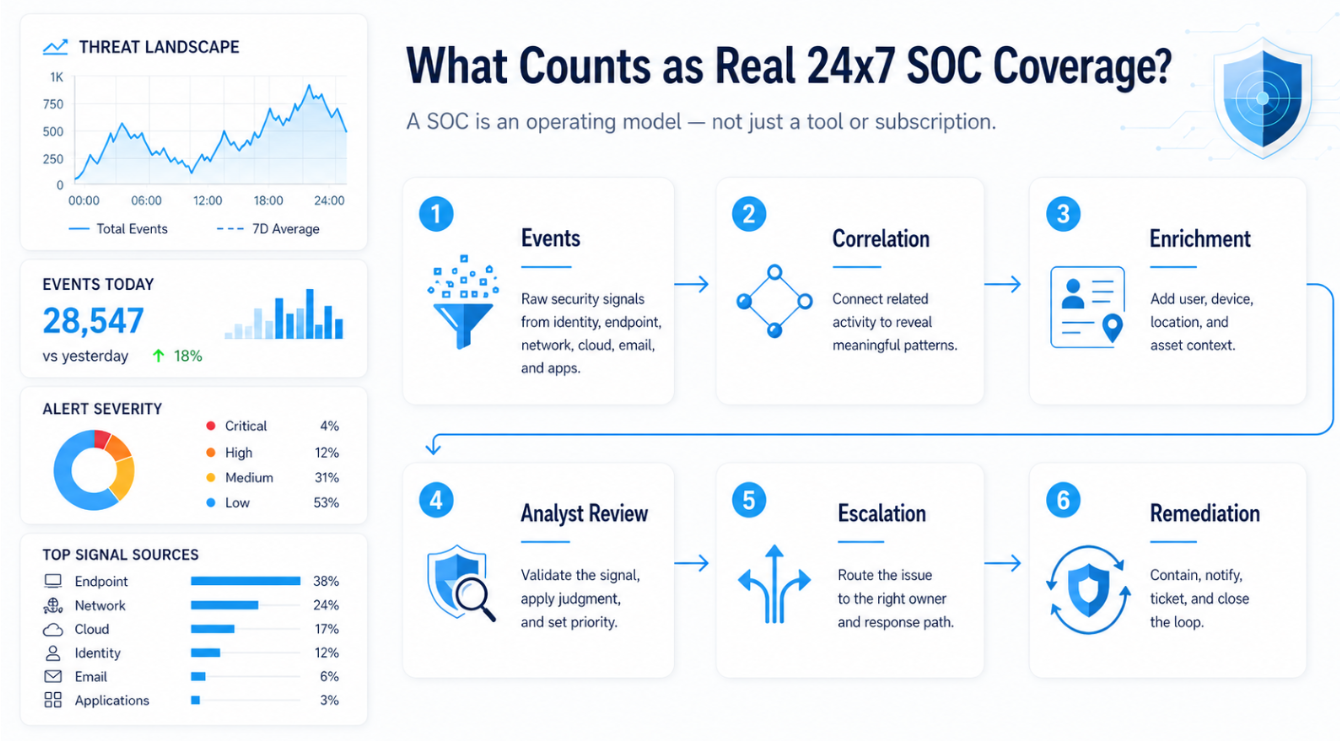
A functioning SOC is not just a tool, dashboard, or subscription.
It is an operating model that connects technology, people, process, and accountability.
Real 24x7 SOC coverage usually includes six core stages:
- Events: Raw signals from identity, endpoint, network, cloud, email, applications, and other systems. Most events are not incidents on their own. They need interpretation.
- Correlation: Individual alerts rarely show the full scope of an issue. A failed login is noise — until it’s tied to unusual access, a new location, or suspicious endpoint activity.
- Enrichment: SOCs add context so teams can make more intelligent response decisions. Is the user privileged? Is the device managed? Is the asset critical? Is the activity expected?
- Analyst Review: A trained analyst validates the signal, weighs the context, and determines whether the issue is benign, suspicious, urgent, or worth tracking.
- Escalation: The right people are notified through the right path. Severity, ownership, and response expectations should be clear before an event occurs.
- Remediation: The loop is closed. That may mean disabling an account, isolating a device, blocking access, opening a ticket, notifying an owner, or guiding the next response step.
A SOC that only reports a problem is providing visibility. Real coverage helps move the issue toward resolution.
Why AI Enrichment Alone Is Not Coverage
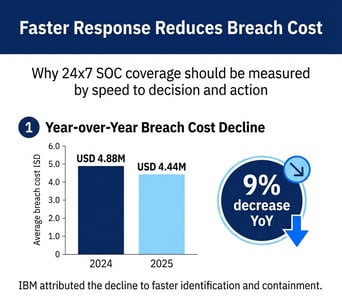
The business case is straightforward: faster response can reduce blast radius. IBM’s 2025 Cost of a Data Breach Report found that the global average breach cost fell 9% year over year, from USD 4.88 million to USD 4.44 million, a decline IBM attributed to faster identification and containment.
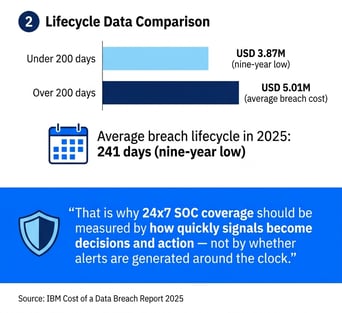
IBM’s lifecycle data reinforces the point: breaches identified and contained in under 200 days cost USD 3.87 million on average, compared with USD 5.01 million for breaches lasting more than 200 days.
That is why 24x7 SOC coverage should be measured by how quickly signals become decisions and action — not by whether alerts are generated around the clock.
Enrichment is not the same as coverage.
A cleaner alert still needs an owner. A risk score still needs validation. A recommended action still needs authority, coordination, and follow-through. If the workflow stops at “the system explained the alert,” the organization has improved detection context, not complete response capability.
That is why human analysts still matter. Security operations require judgment, not just speed. Analysts can tell when activity is unusual but business-appropriate, or when something looks minor technically but carries operational risk. They connect signals across identity, endpoint, network, and cloud environments, ask better questions, and coordinate with the people who understand the environment.
The strongest SOC model is not AI versus analysts. It is AI supporting analysts, so teams can move faster without losing context, accountability, or control.
The value is not only in reading alerts. It is in turning security signals into decisions and actions.
Ready to Pressure-Test Your SOC Coverage?
If your current model stops at alerts, dashboards, or after-hours notifications, there may be gaps in the workflow.
Ask whether your team or provider can:
- Review and triage alerts after hours, not just collect them.
- Correlate activity across identity, endpoint, network, cloud, email, and applications.
- Add context before escalating an alert.
- Assign severity and ownership consistently.
- Support containment, and resolution workflows.
- Improve detections and workflows over time.
The question is whether your team can move from detection to decision to action at any hour, with clear ownership and follow-through.
Not sure where your coverage gaps are?
Or, see how the VectorUSA SOC operates and compare the workflow against what you have in place today.
Share this article


Ready to unlock the power of your technology?