
Many organizations are not short on cybersecurity tools. They are short on clear decisions.
Endpoint tools flag risky devices. Email tools catch suspicious messages. Firewalls surface unusual traffic. Identity platforms show access gaps. Scanners find exposed systems. Dashboards keep adding alerts.
More signals do not always create more progress. Leaders still need to know what matters, who owns the fix, and how to prove risk is going down.
That is why cybersecurity is not just a tool stack problem. A stronger cybersecurity strategy starts with risk, visibility, ownership, and response.
Tools Need Priorities
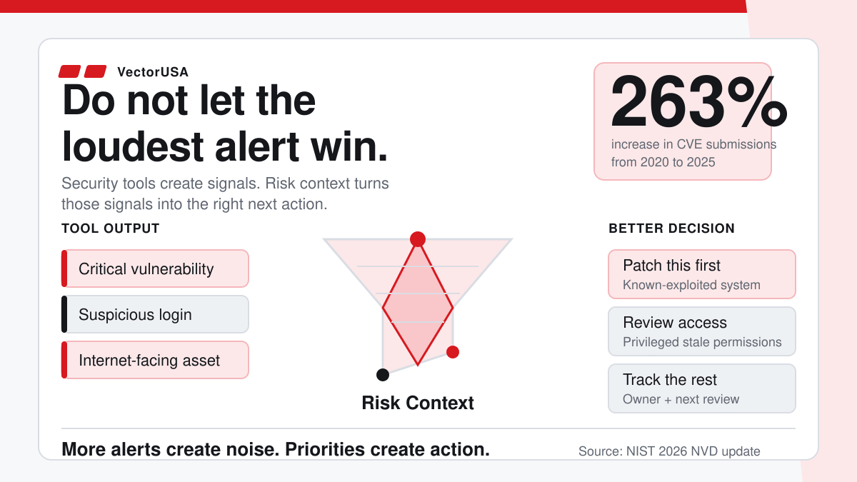
A tool can show a vulnerability, suspicious login, exposed asset, or policy gap. It cannot decide which issue creates the most business risk. That decision needs context.
Which systems support critical operations? Which users have privileged access? Which findings are being exploited? Which fixes are realistic?
Without priorities, security teams chase whatever is loudest. That is not a strategy. It is a queue.
A scanner may find hundreds of critical vulnerabilities. But the first fix should often be the internet-facing system with known exploitation, privileged access, or critical data. NIST's 2026 NVD update moved toward risk-based prioritization after CVE volume increased 263% from 2020 to 2025.
Start With Better Cybersecurity Questions
A practical program should answer these questions:
-
Which assets, users, and data matter most?
-
Where do we have the least visibility?
-
Which identity risks could create the most damage?
-
Which vulnerabilities should be fixed first?
-
Who owns the response when something goes wrong?
-
What evidence do we need for insurance, compliance, or executive reporting?
These questions move security from tool management to risk management.
Identity and Vulnerability Management Should Come Early
If leaders do not know where to begin, identity is a strong first review. Privileged accounts, stale access, weak authentication, and unmanaged permissions can create major exposure.
Cybercriminal collective Scattered Spider has used social engineering against help desks, password resets, MFA fatigue, and MFA token manipulation. This shows why identity security is not only a technical control; it is also a process issue.
Vulnerability management is another practical starting point. The goal is not to fix every finding at once. That is rarely realistic. The goal is to identify what matters, prioritize remediation, track progress, and make better decisions over time.
Real Incidents Show the Gap
Change Healthcare, a UnitedHealth Group company, was hit by ALPHV/BlackCat ransomware in February 2024. Attackers logged into a Citrix remote-access portal with stolen credentials. The portal did not have multi-factor authentication. Andrew Witty's Senate testimony described compromised credentials, lateral movement, data exfiltration, and ransomware nine days later. UnitedHealth also reported $867 million in Optum Insight business disruption effects from the cyberattack.
The gap was tied to identity, ownership, visibility, and response.
The Caesars Entertainment incident makes a similar point. In 2023, the company said attackers used social engineering against an outsourced IT support vendor and stole a copy of its loyalty program database.
Tools matter. But strong cybersecurity also needs vendor oversight, help desk procedures, access controls, and clear ownership.
Compliance Is Not the Same as Security
Compliance can help. It proves that certain requirements are being addressed. But it does not always prove that controls are effective, tested, or aligned to current business risk.
Leaders need both compliance evidence and practical security improvement.
The SEC's cybersecurity disclosure rule reinforces this shift. Cybersecurity is now a business governance issue, not just an IT issue. Public companies may need to disclose material incidents and describe how they assess cyber risk, who manages it, and how leaders oversee it.
That means organizations need more than alerts and reports. They need a process for business impact, ownership, escalation, and progress.
VectorUSA helps organizations identify gaps, prioritize risk, improve visibility, and strengthen cybersecurity programs. That can include readiness assessments, identity review, vulnerability management, architecture guidance, remediation planning, and executive reporting.
The goal is not to buy more security. The goal is to reduce avoidable exposure and give leadership a clear view of progress.

FAQs: Compliance vs. Security
What is the difference between compliance and security?
Compliance means meeting specific requirements from a law, regulation, framework, contract, insurer, or industry standard. Security is the broader discipline of reducing cyber risk across people, processes, systems, identities, data, and response capabilities. A company can be compliant at a point in time and still have security gaps if controls are poorly maintained, ownership is unclear, or risks are not prioritized.
Why is compliance not the same as cybersecurity?
Compliance usually asks whether required controls exist and can be documented. Cybersecurity asks whether those controls are working, whether they reduce meaningful risk, and whether the organization can prevent, detect, respond to, and recover from incidents. Compliance can support a cybersecurity strategy, but it should not replace risk-based security planning.
Can an organization be compliant but not secure?
Yes. An organization may pass an audit while still having unmanaged vulnerabilities, excessive user access, incomplete asset visibility, weak incident response processes, or security tools that are not being used effectively. Compliance is an important checkpoint, but security drives understanding, managing, and mitigating risk or critical data being disclosed, altered, or denied.
What should a cybersecurity strategy include beyond compliance?
A practical cybersecurity strategy should include asset visibility, identity review, vulnerability management, policy alignment, incident response planning, backup readiness, executive reporting, and clear risk priorities.
Where should an organization start?
- Understand which business functions and services generate revenue.
- Prioritize confidentiality, integrity, and availability based on their impact on those operations.
- Identify who has access to critical systems and data.
- Determine which vulnerabilities create the most risk.
- Use the following inputs to shape a focused roadmap and establish clear priorities:
- Regulatory requirements
- Penetration tests
- Security program assessments
- Inventories of critical business functions and services
- Current security tooling
Sources Cited
- NIST: NIST Updates NVD Operations to Address Record CVE Growth
- FBI and CISA: Scattered Spider Cybersecurity Advisory
- U.S. Department of Justice: Alleged Scattered Spider Member Arrested and Extradited
- SecurityWeek: Change Healthcare Confirms BlackCat Ransomware Attack
- Senate Finance Committee: Andrew Witty Testimony on the Change Healthcare Cyberattack
- UnitedHealth Group: 2024 Financial Results
- Caesars Entertainment: SEC Form 8-K Filing
- SEC: Cybersecurity Risk Management, Strategy, Governance, and Incident Disclosure Rule
Share this article


Ready to unlock the power of your technology?