
Public sector organizations are under pressure from every direction.
Modernize services. Protect citizen data. Meet compliance expectations. Respond faster when something goes sideways. Easy, right? Not exactly.
For state and local agencies, cybersecurity has moved well beyond firewalls, antivirus, and annual check-the-box assessments. It is now tied directly to service continuity, public trust, funding requirements, audit readiness, and operational resilience.
The question isn't, “Do we have enough cybersecurity tools?” but rather, “Are we actually using the tools to reduce risk?”
Most agencies do not suffer from a shortage of security tools. They suffer from underutilized capability. Tools may be available, teams may be aware of them, and licenses may be active, but that does not mean the capabilities are being fully utilized.
“There is no shortage of security tools,” says Ace Sklar, SOC Manager at VectorUSA.
“Most organizations already own more security tools than they actively use. Environments are saturated with technology, yet much of that capability remains untapped. Real progress comes from combining the right tools with hands-on execution, operational discipline, and a focus on outcomes, not simply adding more products to the stack.”
For public sector leaders, the real question becomes: Can our teams see what is happening, respond with confidence, remediate issues quickly, and prove progress over time?
The agencies that make the greatest cybersecurity gains are often not the ones with the largest technology budgets. They are the ones that operationalize the capabilities they already have, align security efforts to measurable outcomes, and continuously improve their ability to detect, respond, and recover.
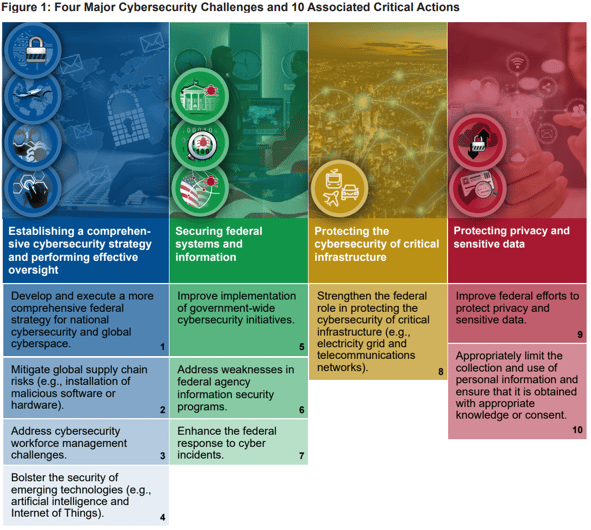
That is where a practical cyber resilience framework matters. In a report titled Urgent Action Needed to Address Critical Cybersecurity Challenges Facing the Nation, GAO identifies ongoing federal cybersecurity weaknesses:
-
Securing federal systems and information
-
Lack of effective cybersecurity oversight
-
Workforce shortages
-
Challenges protecting critical infrastructure
-
Weak implementation of cybersecurity programs
What is cyber resilience in the public sector?
Cyber resilience is an organization's ability to respond and recover from cyber threats while continuing to deliver essential services.
For public sector organizations, that means protecting systems that support public safety, utilities, transportation, finance, education, courts, and citizen services. When these systems are disrupted, the impact is not just technical. It can affect communities, employees, public confidence, and day-to-day operations.
CISA’s Cross-Sector Cybersecurity Performance Goals were created to help organizations focus on foundational practices that reduce risk to critical infrastructure operations. NIST CSF 2.0 also gives government agencies and other organizations a shared way to understand, assess, prioritize, and communicate cybersecurity risk.
The Public Sector Cyber Resilience Framework
A strong public sector cybersecurity program should connect strategy to day-to-day operations. The following framework gives agencies a practical path to improving visibility, response, accountability, and resilience.
1. Govern: Define ownership before the incident
Cybersecurity operations break down when ownership is unclear.
Who owns risk decisions, escalation, communication, and remediation accountability? Without defined roles and workflows, agencies are forced to improvise during incidents.
Governance creates structure. It turns cybersecurity from a collection of reactive tasks into an accountable operational model.
This matters even more in the public sector, where agencies often manage complex stakeholder environments, shared services, procurement constraints, and compliance expectations. Public sector cybersecurity plans should connect high-level goals to finite, practical objectives that reduce specific risks. These best practices establish repeatable response workflows before an incident occurs.
2. See: Build visibility across identity, endpoint, network, cloud, and vulnerabilities.
You cannot protect what you cannot see.
Public sector environments often combine legacy systems, cloud platforms, remote users, shared infrastructure, third-party applications, and critical operational systems. That complexity creates blind spots.
Effective visibility should extend across identity, endpoints, networks, cloud environments, and vulnerabilities in a way that helps teams prioritize risk and respond faster.
This is where a SOC becomes operationally valuable. VectorUSA’s SOC provides centralized monitoring, investigation, vulnerability management, remediation support, incident response, automation, and compliance mapping within a unified operational model.
For agencies, the value is practical: better visibility leads to faster prioritization, clearer risk decisions, and reduced alert fatigue. Because not every alert is a crisis. The challenge is knowing which signals matter most.
3. Detect: Move from alerts to meaningful signals
Public sector teams do not need more alerts. They need better detection.
A modern SOC should correlate activity across identities, endpoints, networks, cloud environments, and vulnerabilities to identify threats that matter. The goal is not just detecting suspicious activity, but to turn fragmented data into clear, actionable intelligence.
Threat intelligence sources like MS-ISAC provide valuable context, but agencies are still missing key security visibility inside their own environments. Effective detection helps teams quickly answer critical questions: What happened? Which systems are affected? Is this isolated, misconfigured, or an active threat?
Detection should reduce confusion and accelerate response.
4. Respond: Create a repeatable path from investigation to action
A strong SOC should support investigation, triage, escalation, containment, and communication through repeatable workflows. For public sector teams managing lean staffing and competing priorities, response cannot depend on improvisation.
VectorUSA’s SOC combines human-led investigation with automation, escalation, remediation support, and compliance-aligned reporting. The goal is not just to detect and notify, but to help agencies move from detection to resolution with accountability and operational clarity.
Public sector organizations are not just buying tools. They are investing in confidence that incidents can be handled, documented, and resolved effectively.
5. Remediate: Fix what creates recurring risk
Detection without remediation creates recurring operational risk. Unpatched vulnerabilities, misconfigurations, overprivileged accounts, and outdated firewall policies continue to expose agencies long after alerts are generated. Remediation is what connects cybersecurity operations to measurable risk reduction.
That includes prioritizing critical vulnerabilities, validating patches, closing identity gaps, reviewing exposed services, and confirming fixes actually worked. It also supports audit readiness and leadership reporting by showing not just that issues were identified, but that they were addressed.
This is a major difference between cybersecurity activity and measurable resilience progress.
6. Prove: Report outcomes leadership can understand
Cybersecurity reporting should help leaders make decisions, not force them to interpret technical details.
Executives, boards, councils, auditors, and funding stakeholders need to see what matters most: where risk is increasing, where resilience is improving, and where investment is still needed.
That means moving beyond “Have we been breached?” A clean report should show:
-
How quickly critical threats are detected and contained
-
Which vulnerabilities or systems create the most risk
-
Where remediation is improving security posture
-
Where staffing, funding, or technology gaps still exist
-
How investments are reducing risk and supporting compliance
When reporting connects cybersecurity work to risk reduction, resilience, and ROI, leadership can see the value clearly. Security becomes easier to defend, easier to fund, and easier to treat as a strategic priority.
NASCIO’s state CIO priorities continue to reflect where the public sector conversation is heading: modernization, security, identity, cloud, analytics, and accountability are connected.
VectorUSA’s SOC roadmap supports this direction through KPI dashboards, compliance mapping, monthly reporting, and quarterly executive reviews. That turns cybersecurity from a technical function into an operational management system.
Public sector cyber resilience starts with operations
Cyber resilience is not built in a single project, but a journey that takes time. It is built through repeatable operations. Govern the program. See the environment. Detect meaningful threats. Respond with structure. Remediate the root issues. Prove progress with reporting.
That framework gives public sector organizations a practical path forward, whether they are just starting to formalize cybersecurity operations or looking to mature an existing program.
The agencies that make the most progress will not be the ones with the most tools. They will be the ones that connect visibility, response, remediation, and reporting into one operating model.
That is the point of a modern SOC. And it is exactly where VectorUSA can help public sector teams move from cybersecurity activity to measurable resilience.
See how VectorUSA helps public sector organizations strengthen cybersecurity operations with SOC monitoring and compliance-aligned reporting.
Share this article


Ready to unlock the power of your technology?